New Swiss Thinking and Working Politically Network
What is our story?
The story begins with a small group of people who work directly or indirectly for the Swiss development and economic cooperation. They had attended The Policy Practice and ODI training on Political Economy Analysis in Action and believe that considering power dimensions at every stage of the project cycle is essential for sustainability and impact.
These individuals worked hard to apply their lessons, skills, and knowledge—integrating political economy analysis (PEA) into project design, reviews, strategies. Yet, they all arrived at the same question: "What’s next? How can I move further along the learning curve?"
The answer was simple: come together. They decided to establish a Swiss Cooperation Community of Practice on Political Economy. This is not an introduction to PEA—this is for those who already have experience and want to exchange, reflect, and grow together.
What do we want to build together?
- A shared space for knowledge exchange: An open and safe environment where we discuss experiences, challenges, and lessons learned.
- A platform for growth and learning: A community where we deepen our understanding of PEA and support each other in refining our skills.
- A network for problem-solving: A space to tackle common challenges and develop practical solutions together.
- A collaborative effort to advance practice: Co-create, refine, and share tools and approaches that make PEA more impactful in our work.
How will it work?
- We thought about up to four gatherings per year, each lasting 1.5 hours depending on the dynamic
- Practical focus on real-life cases and shared challenges in PEA.
- Open-ended timeline— as long as it makes sense and there’s interest.
The first meeting?
It will be held online on Thursday 27 March from 1pm to 2:30pm. It will explore “How does political economy differ and complement other approaches?”.
This exchange will be the opportunity to discuss recent experiences from SDC in Burkina Faso, where PEA informed a conflict analysis, and Helvetas in Bosnia and Herzegovina, where PEA was applied taking three key entry-points: peacebuilding and conflict prevention, state-building (incl. fragile state and state capture), and gender equality and social inclusion. TPP Director Laure-Hélène Piron will share her insights on how PEA can be combined with other approaches.
If you would like to join this community of practice and attend our launch meeting, please contact Andreas Weber, SDC PEA lead.
Julie Smolnitchi, skat consulting
Laure-Hélène Piron, The Policy Practice
Craig Hatcher, Helvetas
Andreas Weber, SDC
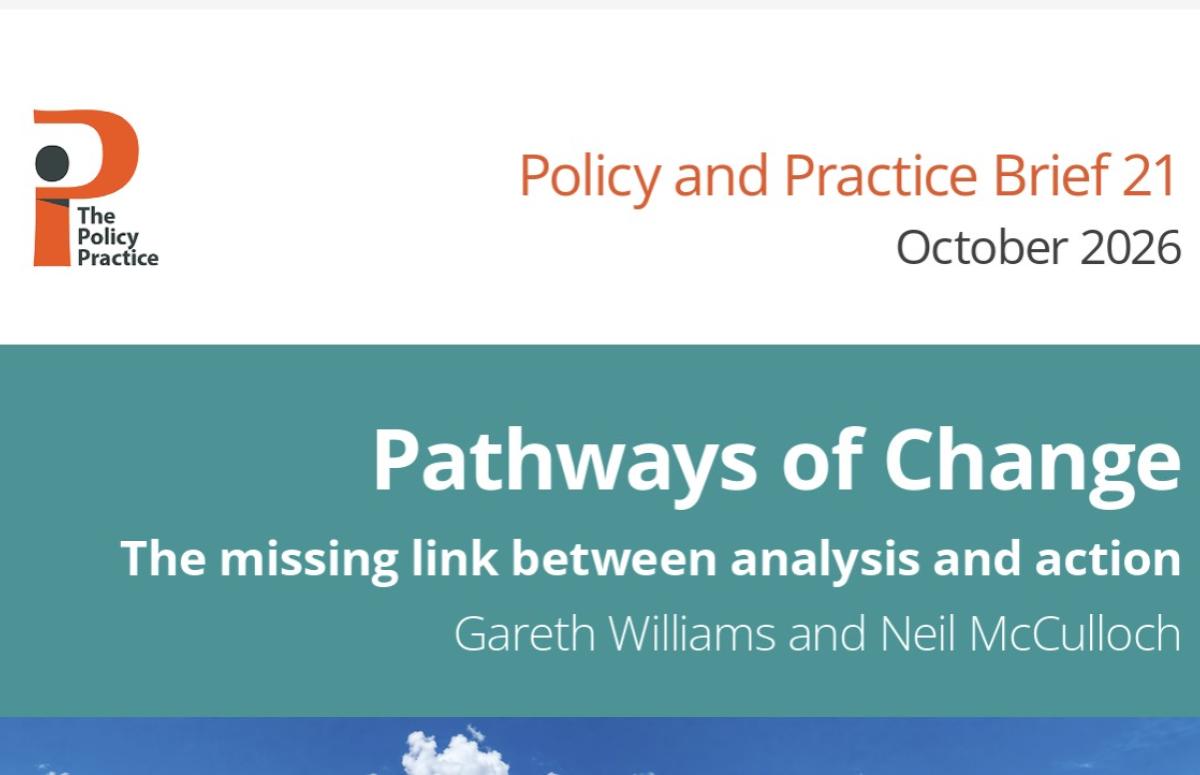
Policy and Practice Brief 21: Pathways of Change
Our new Policy and Practice Brief by TPP Directors Gareth Williams and Neil McCulloch sets out the Pathways of Change framework, a practical link between political economy analysis and action. Using examples from Ghana and Thailand, it shows how external partners can support change driven by domestic actors, based on a realistic analysis of how change might happen.
Can we still achieve peace?
On the day US troops formally withdrew from Iraq, TPP Principal Niki Palmer asks if we can still achieve peace and suggests how to improve peacebuilding interventions.
Podcast: Subsidies and Social Protection - Reforms for a Sustainable Transition
Why are subsidies so difficult to reform, even when more effective alternatives exist? In this podcast by Socialprotection.org, TPP Director Neil McCulloch examines the political, institutional and economic challenges that have made subsidy reform one of the most complex issues in social policy.